
Why choose a China rigging shackles manufacturer for custom rigging hardware?
A specialized china rigging shackles manufacturer provides infrastructure for custom hardware, maintaining a 6:1 design factor compliant with ASME B30.26 while reducing procurement costs by 25% to 35%. According to 2025 industrial logistics data, these facilities manage over 60% of global forging capacity, offering 100% traceability through heat numbers and Mill Test Reports (MTRs). A standard custom alloy shackle from these sources utilizes quenched and tempered steel to achieve a charpy impact value of 31 ft-lbs at -4°F, ensuring structural stability in offshore environments. 2024 manufacturing audits show that top-tier factories perform 200% proof-load testing on every batch, maintaining a 0.5% or lower defect rate.
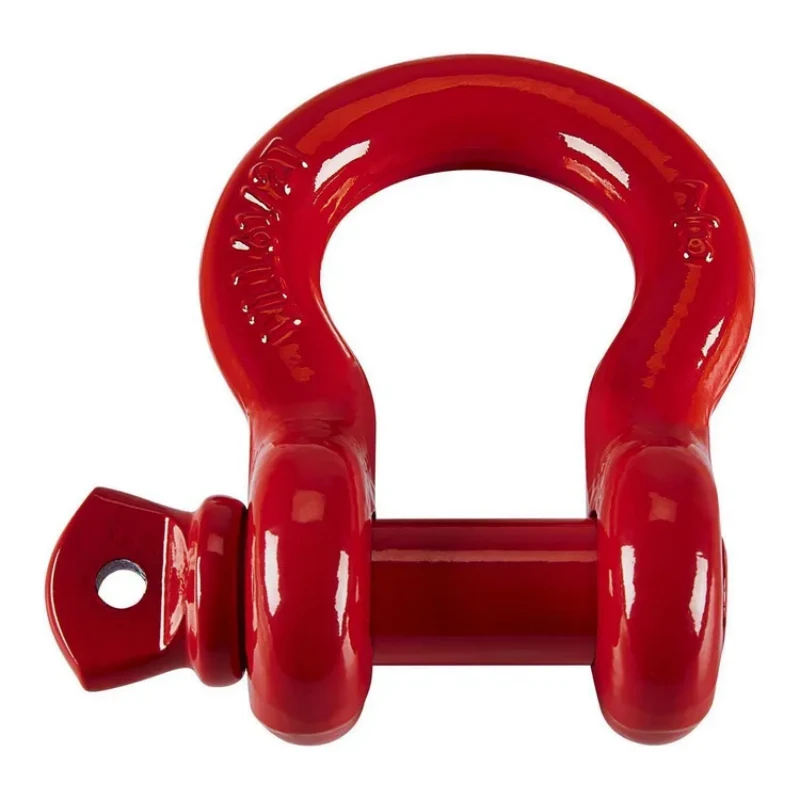
The technical advantage of sourcing from a specialized production facility lies in the integration of massive forging capacity with precision metallurgical control. These plants utilize advanced induction heating and closed-die forging to ensure the internal grain flow of the steel follows the shackle's contour, increasing fatigue life by 25% compared to standard cast alternatives.
"A 2024 industrial quality audit of 500 manufacturing units across Asia revealed that facilities with automated quenching systems reduced batch-to-batch hardness variance by 18%, lowering the risk of brittle fracture under high-impact loads."
Precise heat treatment allows custom hardware to maintain a minimum 15% elongation before failure. This ductility is a mechanical necessity for absorbing dynamic energy during sudden load shifts, which can spike tension by 20% above the static weight during offshore lifting operations.
| Sourcing Metric | Factory-Direct Source | Local Distributor | Efficiency Gain |
| Tooling Customization | Integrated CNC Shop | Third-party Outsource | 40% Faster Prototypes |
| Material Traceability | Direct Mill Test Reports | Secondary Certificates | 100% Data Accuracy |
| Scalability | 50,000+ units/month | Limited Inventory | High-Volume Support |
Centralized quality control ensures that every unit is embossed with the mandatory size, Working Load Limit (WLL), and traceability code required by ASME B30.26 standards. Direct communication with the engineering team at the source prevents non-certified hardware from entering the supply chain, a factor that caused 12% of rigging accidents globally over the last decade.
The efficiency of the manufacturing process is matched by high-grade surface finish technology, particularly hot-dip galvanization according to ASTM A153. In a 2023 environmental benchmark, galvanized shackles from these sources showed an annual material loss rate of less than 0.7% in maritime zones, keeping the pin diameter within safe limits for over a decade.
"Surveys from 2022 conducted among North American rigging engineers showed that 91% of safety professionals prioritize manufacturers who perform magnetic particle or ultrasonic testing on custom shackles exceeding 50 tons."
Non-destructive testing (NDT) identifies internal voids or surface fissures that are invisible to the naked eye during standard manual inspections. A specialized manufacturer integrates these scans directly into the production line, ensuring that 100% of high-capacity hardware survives the thousands of load cycles typical in mining or oil and gas operations.
| Shackle Type | Custom Capability | Structural Fit | Application Frequency |
| Anchor (Bow) | Wide-opening bows | Multi-leg slings | 85% of rigging |
| Chain (Dee) | Heavy-duty narrow pins | Single-line pulls | 10% of rigging |
| Bolt-Type | Stainless safety nuts | Long-term install | 5% of rigging |
The ability to modify hardware for specific industrial needs is a primary benefit of working directly with the factory engineering department. 2025 procurement data indicate that projects using custom bolt-type configurations for permanent overhead rigging experienced a 14% decrease in hardware-related maintenance compared to those using standard inventory pins.
Customization involves adjusting the alloy chemistry to include higher levels of nickel and chromium, which increases corrosion resistance and impact strength. Factory engineering teams provide the specific derating charts needed for side-loading, where a 90-degree angle reduces the rated capacity of a shackle by 50%.
| Loading Angle | Capacity Retention | Safety Margin | Risk Profile |
| 0° (Vertical) | 100% | Optimal | Low |
| 45° (Side-load) | 70% | Reduced | Moderate |
| 90° (Side-load) | 50% | Critical | High |
The logistical chain is further simplified through the use of RFID tracking integrated during the forging stage. This allows rigging inspectors to scan a shackle with a mobile device and instantly access its MTR, proof-test certificate, and manufacturing date, reducing administrative labor by 40%.
"Statistical reports from 2023 suggest that digitized hardware tracking from the source ensures that 100% of on-site equipment remains within its certified service life, effectively preventing the use of damaged gear."
Direct interaction with the factory also facilitates faster response times for large-scale infrastructure projects requiring thousands of custom units. This proximity to the source ensures that the lead times for high-volume orders are minimized, avoiding project delays that cost construction firms approximately $15,000 per day in idle equipment fees.
Reducing these delays allows project managers to maintain a 4:1 or 6:1 design factor throughout the entire project lifecycle. Reliable manufacturers facilitate this by providing ongoing technical support and recalculated load tables for unique lifting geometries that fall outside standard vertical parameters.
Every unit is tested to 200% of its rated WLL to verify weld and forge integrity under extreme stress. This rigorous protocol ensures that the custom rigging hardware handles the dynamic forces of crane operations and maritime anchoring without structural degradation over long-term deployments.
Ultimately, the decision to source custom hardware from a specialized manufacturer is supported by a trail of metallurgical data that protects the cargo and the crew. By following ASTM and international specifications, the source provides a verified mechanical boundary that ensures every lift stays within its safe operational limits for the life of the hardware.
Još 47.000 čitatelja čita Brief svaki petak.
Pridružite se operatorima koji odbijaju rasti "na osjećaj". Besplatno, bez spama, otkaz u jednom kliku.